Sunday, June 12, 2016

WHERE DO SEEDLESS WATERMELONS COME FROM?


 WHERE DO SEEDLESS WATERMELONS COME FROM?


How do seedless watermelons get that way?

My daughter loves watermelon and I was thinking she was getting big enough to have a seed spitting contest. But watermelon seeds seem to be vanishing. I'm used to seedless grapes but only recently became aware of this watermelon situation. Seedless watermelons have been growing in popularity since 1990. From the standpoint of a plant, the whole point of fruit is produce seeds, so I wondered what kind of hanky panky was going on to produce seedless watermelons. Turns out that they are like mules, self-sterile hybrids and involve a lot of work.
Diploid
Watermelon plants are usually diploid, like us, meaning they have two sets of chromosomes, the packages of DNA with instructions for life.
Triploid
Seedless watermelons are triploid. They have three sets of chromosomes. This odd number results in them being sterile and not producing seeds. The way they become triploid is by mating a diploid male with a tetraploid female. Tetraploids have four sets of chromosomes.
Tetraploid
The way you get tetraploids is by applying a chemical called colchicine which messes with cells as they are dividing. You add it to diploid seedlings and then some cells become tetraploid. You have to cultivate these over several generations to get enough that produce enough viable seeds with suitable traits.
Mixing It Up
Watermelon plants have male flowers and female flowers. The female flowers have a little pea-sized melon behind it. You remove the male flowers on the tetraploid plants because the female tetraploid flowers produce triploid fruit. It doesn't work with a male tetraploid and female diploid. Pollination can be done by hand or using bees.
Go Time
Seeds from the triploid fruit grow into triploid plants. They don't produce much pollen, so you plant some diploid plants. This pollen stimulates the triploid female flowers to produce fruit. Because the number of chromosomes is not compatible, they don't have seeds.
The seedless watermelons are smaller and rounder. They are supposed to be sweeter and last longer. But do you think it's really worth all the extra work?

GROWING SEEDLESS WATERMELONS


 Seed Production. The obvious question asked about growing seedless watermelons is: "How does one obtain seed of a seedless watermelon?" Obviously, you cannot save seed from a seedless watermelon. So, where do the seeds come from? Simply stated, the number of chromosomes (the threadlike bodies within cells that contain the inheritance units called genes) in a normal watermelon plant is doubled by the use of the chemical colchicine. Doubling a normal (diploid) watermelon results in a tetraploid plant (one having four sets of chromosomes). When the tetraploid plant is bred back, or pollinated, by a diploid or normal plant, the resulting seed produces a triploid plant that is basically a "mule" of the plant kingdom, and it produces seedless watermelons. Seed of seedless varieties are available from most major seed companies.
General Climatic Requirements. Seedless watermelons are a warm-season crop, preferring relatively high temperatures for optimum growth. Daytime temperatures of 80 to 95 degrees F. and night temperatures of 60 to 70 degrees F. are best. When temperatures are lower, plant growth is slowed considerably. With favorable weather, seeded fields can produce ripe fruit in 85 to 100 days.
Planting. Poor seed germination is the main problem with growing seedless watermelons. When direct seeding, the soil temperature should be minimum of 70 degrees F. at a depth of 4 inches. Soil temperatures below 70 degree F. will reduce germination and emergence. When growing transplants, use 12- to 2-inch seedling cells or peat pellets. Soak the planting medium thoroughly, and let drain 4 to 6 hours before sowing. Plant 1 or 2 seeds per cell or pellet. The greenhouse temperature should be 75 to 85 degrees F. during the germination period. Do not allow the growing medium to become dry, but do not over water during initial germination. Begin watering, as needed, after 10 to 15 percent of the seedlings have emerged. Plants should be ready for transplanting in 3 to 4 weeks. Transplants should have not more than 3 true leaves when set in the field. Use of older, larger transplants can cause slow, stunted growth and poor yields. In-row and between-row spacing is generally 48 X 80 inches.
Pollination. The male and female flowers are born separately on the watermelon plant. Female flowers must be pollinated for fruit to set. Also, cross pollination must occur between a seedless and a regular type watermelon for seedless fruit to be produced. This is best accomplished by planting a standard watermelon variety in the garden. Approximately one-third of the plants in the garden should be of the standard or 'pollinator' variety. Honey bees are the principal insects that pollinate watermelons. Pollination is a must, and poor or partial pollination may result in misshapen fruit and no seedless melons.
Harvesting. The lower side or 'ground spot' of the fruit should be cream-colored or yellowish. Thump fruit to check for ripeness. The result will vary. Generally, a solid sound indicates ripeness, while a sharp echoing sound indicates a greener fruit. The tendril or 'tail' which occurs in the axils of leaves (where the leaf attaches to the vine) along the stem can be used as an indicator of ripeness. Experienced harvesters say that if the 2 tendrils nearest the fruit are dry, the seedless watermelon is ripe. It is important to note that the first few mature melons in the garden may frequently contain small seeds. This condition is most prevalent under stressed conditions, such as low soil moisture, insufficient fertilizer, temperature extremes, or disease pressure, which affect normal plant development.
Each planting of seedless watermelons actually produces 3 different types of watermelons -- the regular seeded watermelons (from pollinator plants), the true seedless melons, and a light-green tetraploid melon that produces a very limited number of seeds, from which next year's planting can be made.


Saturday, June 11, 2016

13 Common Ailments You Can Heal with Ashwagandha

13 Common Ailments You Can Heal with Ashwagandha

 Do you suffer from stress, memory fog, fatigue, or an inability to lose weight? Chronic stress takes a ghastly toll on our bodies as well as our minds. Many degenerative diseases, as well as premature aging, are associated with chronic nervous tension.Discover what Ayurveda has known for hundreds of years and what scientists have confirmed.


Ashwagandha: A powerful adaptogen herb that enhances the body’s resilience to stress, enhances the function of the brain and nervous system, and improves memory. For more than 5000 years of Indian Ayurveda (traditional medicine) Ashwagandha has been used as a Rasayana.
Rasayana is described as an herbal or metallic preparation that promotes a youthful state of physical and mental health and expands happiness (Changhadi, 1938).
This herb is known as a rejuvenator tonic. Modern scientific studies have been carried out and proven Ashwagandha’s anti-stress activities among other strong benefits.Ashwagandha is used as a household remedy by AyurvedicIndians, who consider it as the best tonic for old people and children, and as an aphrodisiac by young people.


Parts of Ashwagandha Herb

Luckily the only negative part of this plant is its smell. Because the root smells like horse (“ashwa”), it is called Ashwagandha. Literally the name means: on consuming it gives the power of a horse. Yum.
  • The root of Ashwagandha is regarded as tonic, aphrodisiac, narcotic, diuretic, anthelmintic, astringent, thermogenic and stimulant. Ashwagandha root is commonly found as a fine sieved powder which can be mixed with water.
  • The leaves are bitter and are recommended in fever and painful swellings.
  • The flowers are astringent, depurative, diuretic and aphrodisiac.
  • The seeds are anthelmintic and combined with astringent and rock salt supposedly remove white spots from the cornea.

Benefits of Ashwagandha

  1. Body Weight: Weight-gain or the inability to lose weight is often accompanied by high levels of cortisol (a stress hormone) within the body. Ashwagandha can help reduce cortisol levels, therefore encouraging weight-loss. It has also been effective in lowering fasting blood sugar levels and improving lipid profiles.
  2. Mood: Investigations support the use of Ashwagandha as a mood stabilizer in clinical conditions of anxiety and depression. Its effects are comparable to those of powerful pharmaceutical drugs.
  3. Stress Induced Diseases: Lowers stress markers, therefore lowering likelihood of arteriosclerosis, premature ageing, arthritis, diabetes, hypertension and malignancy.
  4. Exercise: It significantly reduces the cortisol content of adrenals during exercise, therefore increasing endurance and time to fatigue.
  5. Mind and Memory: Ashwagandha belongs to a sub-group of Rasayanas known as Medhya Rasayanas. Medhya Rasayanas promote intellect and memory.It has a Cognition Promoting Effect and is useful in children with memory deficit and in old age loss of memory(Singh, 1993).
  6. Neurodegenerative Diseases: There are dozens of studies that show that Ashwagandha slows, stops, reverses or removes neuritic atrophy and synaptic loss. Therefore it has become a common treatment for neurodegenerative diseases such as Parkinson’s, Huntington’s and Alzheimer’s diseases (Kuboyama, 2005).
  7. Nerve Damage: MimickingGABA, Ashwagandha promotes formation of dendrites (the “fingers” at the end of nerves that communicate with other nerves).Its constituents and the metabolites of its constituents promote the growth of nerves after taking it for 7 days.
  8. Energy– Known as “Indian Ginseng,”used as a general tonic, it promotes energy and improves health and longevity. It has anxiolytic effect and improves energy levels and mitochondrial health.
  9. Reproductive Health: It improves the function of the reproductive system promoting a healthy sexual and reproductive balance. It also acts as a stimulant and increases the sperm count.
  10. Immunity: Ashwagandha improves the body’s defense against disease by improving the cell-mediated immunity. It is also regarded as a promising anti-bacterial agent.
  11. Anti-Ageing: Possessing potent antioxidant properties it helps protect against cellular damage caused by free radicals.
  12. Anti-Inflammatory: Can be taken orally to fight internal inflammation or made into a paste of crushed roots mixed with water and applied to effectively reduce joint inflammation or other swelling.
  13. Anti-Arthritic: Ashwagandha is used as ananalgesic that soothes nervous system from pain response giving it powerful anti-arthritic properties. It has been found useful in clinical cases of Rheumatoid and Osteoarthritis.
As a population we all suffer from stress, and therefore could all benefit from taking Ashwagandha. Plus, with so many other awesome benefits, why not?


Friday, June 10, 2016

This little known herb regulates diabetes and makes ulcers a thing of the past!!! Try this recipe at home


This little known herb regulates diabetes and makes ulcers a thing of the past!!! Try this recipe at home


Tulsi tea is made from the Ayurvedic herb tulsi or also called "holy basil."  It is native to India where it is valued as an energizing beverage and sacred plant.  Tulsi (Ocimum sanctum) is a distant cousin to "culinary basil" but is an entirely unique species with different medicinal properties.

Revered for its remarkable healing qualities, holy basil has been used in Ayurvedic medicine for thousands of years and is one of India's most cherished plants.

"The Hindu scriptures instruct us to look upon tulsi not as a mere plant, but as the divine representative of the God Vishnu or of Lord Krishna."  Yash Rai
More frequently consumed in India than coffee, holy basil or tulsi tea is an energizing drink that is used in Ayurveda to treat lung and heart problems, digestive disorders, mental fog, colds, headaches and inflammation.
Tulsi benefits to health are comparable to some of the Chinese tonics, like gynostemma, or other herbs like gotu kola and ginkgo.
What Does Tulsi Tea Taste Like?
The flavor of tulsi is uniquely spiced, resembling a blend of mint, licorice and clove. The leaves of holy basil contain essential oils that contribute to the fragrance and refreshing flavor.
Tulsi tea is made from the leaves of the plant. The most traditional way to prepare it is to infuse the fresh leaf, dried leaf or powder in hot water much the same way you would the previously mentioned herbs.
It can be served as an iced tea or as a hot tea by itself or with other herbs and spices.  In India it is also used in ghee or clarified butter.  Further below we will share our tulsi tea recipe, but first let's discuss the health promoting elements of this renowned leafy herb.

Holy Basil Benefits

The properties of holy basil or Ocimum sanctum are antiviral, adaptogenic, immune modulating and antibacterial, specifically working with the digestive, respiratory and nervous systems.

Tulsi Benefits as an Adaptogen

Tulsi is known as an adaptogen and contains many phyto-chemicals that act synergistically to promote the bodies natural defense mechanisms toward disease and stress.
Adaptogens help to counteract the negative effects of stress, support the body's natural immune response and help to normalize organ functions.  Tulsi does this by nourishing the nervous system in much the same way that other triterpenoid containing adaptogens do, like ginseng, eleuthero and reishi.

Tulsi has a natural energizing effect on the body, although it contains no caffeine and is considered an herbal stimulant.  Interestingly, when you brew the tea some varieties actually turn a dark brown color similar to that of coffee.  Some say it is actually a good substitute for coffee or caffeinated teas for those trying to reduce their consumption. 


"Tulsi can be combined with other cerebral stimulants such as rosemary, bacopa, and ginkgo to help people with menopausal cloudy thinking, poor memory, attention deficit disorder (ADD) and attention deficit hyperactivity disorder (ADHD) and to speed up recovery from head trauma."   David Winston and Steven Maimes from the book Adaptogens

Immune Modulator and Respiratory Tonic

"It contains hundreds of beneficial compounds known as phytochemicals. Phytochemicals are non-nutritive plant compounds containing protective and health promoting properties."  Dr. Mercola
Holy basil benefits as an adaptogen make it a powerful immune modulator, balancing and strengthening the immune response of the body in fighting antigens such as bacteria, viruses, microbes and allergens. 
It can be taken to both assist and prevent upper respiratory viruses like colds or flus.  It is an expectorant herb with a special affinity for the lungs and has been long used for bronchitis as well as pulmonary weakness.
Taken over a period of time it can have a beneficial effect on asthma and has also been shown to be helpful in relieving allergies and seasonal hay fever symptoms.
Tulsi tea contains a rich amount of bio-available antioxidants that help to boost the immune system and protect the cells from the damaging effects of free radicals, shielding the cell structure from "germs" and other foreign invaders that threaten our health.

tulsi-plant

Anti-Inflammatory Benefits

"Holy basil is classified as a rasayana, an herb that nourishes a person’s growth to perfect health and promotes long life."   David Winston and Steve Maimes from the book Adaptogens
Holy basil has shown significant results as an anti-inflammatory in lab animal research.  "Several experimental studies have confirmed its anti-inflammatory properties and its role in modulation of both cellular and humeral immunity.  Recently its efficacy against inflammatory response, hepatic injury and gastric ulcer has been elucidated in animal studies."  PubMed study
In the book "Beyond Aspirin, Nature's Answer to Arthritis, Cancer and Alzheimer's Disease", it states that holy basil contains the phytonutrient ursolic acid which has been shown to have potential anti-inflammatory activity due to its "significant COX-2 inhibitory effect."
Tulsi benefits also include many other antioxidant, anti-inflammatory compounds, such as eugenol, rosmarinic acid and apigenin, according to "Natural Cancer Cures: The Definitive Guide to Using Dietary Supplements to Fight and Prevent Cancer."
holy-basil-tea-dried-leaves

Sacred Holy Basil Benefits

Ayurvedic physician Dr. Vasant Lad speaks of the plants effects on one's "energy field" and its traditionally viewed benefits as a "sattvic herb", helping to balance the chakra centers of the body.  It is known in India to be very useful for achieving mental clarity and meditative states, working energetically with both the heart and the mind to bestow bhakti or "love and devotion."  According to David Winston, author of "Adaptogens", it strengthens compassion, faith and clarity.
For this reason tulsi is similar to other tonics like reishi, shatavari and asparagus root for its ability to help bridge the heart-mind connection and is known to open one to greater feelings of love.
A Sacred Plant of the Hindu Religion
tulsi-tea-1
In the Hindu religion holy basil is revered as a sacred herb used in meditation, ritual and worship.  It is often symbolically planted outside each Hindu household or courtyard and the seeds are worn to honor the Hindu god Vishnu or Krishna. 
First documented in the Charak Samhita, an ancient Ayurvedic text written two thousand years ago, holy basil is classified as a "rasayana" and is known as an herb that expands happiness by promoting a youthful physical and mental state.  Rasayana herbs are adaptogens and are most effective when used on a regular basis.
holy-basil-benefits-three-types

Three Types of Tulsi Tea

1) Rama Tulsi (Ocimum sanctum) or the Indian name:  Lakshmi tulasi - is the original version, widely cultivated around the world and is usually a short growing plant compared to other varieties.
2) Krishna Tulsi (Ocimum tenuiflorum) or the Indian name:  Krishna tulasi - this kind of tulsi often has a purple-tinged leaf, stem and flower.  It is stronger in flavor and is quite high in triterpene constituents.
3) Vana Tulsi (Ocimum gratissimum) - this is the native wild variety of tulsi that grows throughout India as well as parts of Asia and Africa.  It is known to be particularly high in eugenol.
When choosing high quality dried leaves for tulsi tea it is good to try to use all three varieties as they each have different health enhancing components.  There are some tulsi tea companies that use all three in their prepackaged tea bag blends.

Tulsi Benefits Help To:

  • Enhance energy and physical stamina
  • Stimulate the mind
  • Balance cholesterol levels
  • Support eye health
  • Promote healthy metabolism
  • Normalize blood sugar levels
  • Relieve and protect from everyday stress
  • Boost the immune system
  • Heighten awareness and increase mental clarity

Other Tulsi Nutrients:

  • eugenol
  • triterpenoids
  • B-caryophyllene
  • sesquiterpenes
  • monoterpenes
  • ascorbic acid
  • carotene (vitamin A)
  • rosmarinic acid
  • ursolic acid
  • apigenin
  • calcium
  • iron
  • selenium
  • zinc
  • manganese
  • trace elements

Tulsi Tea Recipe

tulsi-tea-recipe-using-holy-basil
This tulsi tea recipe is particularly refreshing in the heat of summer as an iced cold beverage.  It has a lovely fragrance and blends particularly well with the other herbs used.
Dried tulsi leaf or powder is widely available in bulk quantities or sold as prepackaged teas.  We always use and support organic tulsi products for our own personal consumption.  There are some companies, like Herb Pharm, that also offer holy basil as a tinctured concentrate for ease and therapeutic use. 

Ingredients:

  • 1 quart pure water
  • 4T tulsi leaf or 2T powder
  • 2T lemon grass
  • 1T coriander seeds
  • 1t anise seeds
  • 1/4t vanilla powder or vanilla stevia
  • 1/2t dried ginger root pieces or 1t fresh
  • 1T coconut sugar or raw honey

Directions:

  1. Infuse the above ingredients in boiling hot water for 20 minutes in a 1 quart jar with a lid.
  2. Strain, then add sweeteners and vanilla. 
  3. Drink as a hot cup of tea or serve iced. 
  4. You can store in the refrigerator for several days.
You can add almond milk or other natural sweetenersYacon syrup is particularly tasty in this tea.

Customize Your Own Holy Basil Tea Recipe

tulsi-tea-recipe-ingredients
The more you use and drink tulsi tea the more you will become familiar with what herbs blend well with it.  We personally like to balance our herbal tea formulas with a spice of some kind to help drive in the medicinal qualities of the main herbs.   In this case we used ginger, but other herbs like cinnamon, long pepper, or cayenne, for example, also work. 
Tulsi also makes a great herbal addition to homemade kombucha.  Simply add 4 herbal tea bags of tulsi to your next kombucha recipe

http://givelifenursery.blogspot.com/p/tulsi-vana-tea-basil-holy-basil-or.html

16 moringa recipes you will absolutly love!!!

16 moringa recipes you will absolutly love!!!

 
Moringa Oleifera Recipes
Moringa Tea

There are a number of ways you can enjoy moringa tea.  You can use ½ to 1 teaspoon of dried Moringa leaves to a cup of water. If making the tea with fresh leaves, you can add 2 to 3 compound leaves to boiling water, cook the leaves briefly for a minute, then cover and let steep for 5 – 10 minutes.  Or you can put ½ tsp moringa powder into hot water, cover and let steep. .Add some lemon peel and a little sweetener of your choice, or play around with other combos. I really enjoy moringa/peppermint tea.

Superfood Moringa Smoothie

1 cup coconut milk (can use almond milk, rice milk, etc.)
1 tsp moringa powder or dried leaf  
½ tsp cinnamon
dash nutmeg     
½ tsp turmeric
¼ tsp cardamom (or two cardamom seeds pods)  ½ banana (fresh or frozen)
(can modify with other herbs, spices and superfoods like coriander, ginger, astragalus, etc.)
Blend and drink.

Moringa Leaf Sauce 

5 Tablespoons of Moringa leaf powder      
¼ cup of peanut butter
5 Tablespoons of oil, (vegetable, olive, or palm oil)             
1 Medium onion - chopped
1 quart of water        
Salt and pepper to taste
Red pepper or pepper flakes to taste

Add peanut butter and water and bring to a boil. Cook for 20 minutes on medium heat.  Add oil, Moringa leaf powder and chopped onion. Cover and simmer for 20 minutes.  (or you can wait to add Moringa powder until the last few minutes of cooking)  Add salt and pepper and red pepper to taste. Serve over rice or couscous and with vegetables.


Cooking The Leaves:

Moringa leaves can be cooked any way you would prepare spinach or collards or kale. One easy way to cook them is to steam 2 cups freshly picked leaves for just a few minutes in one cup water, seasoned with onion, vegan butter and sea salt. Vary or add other seasons according to your taste.  You can also parboil them for just a few minutes, then take them out and cool them down with cold water, squeeze the water out with your hands and toss them with some fresh cut tomatoes  and soy sauce for a salad.  Then pour a cup of moringa tea using the water you parboiled them in.


Cooking the Pods:

Young moringa oleifera tree pods are edible whole, with a delicate flavor like asparagus.

They can be used from the time they emerge from the flower cluster until they become too pulpy/woody to snap easily.  The largest ones usable will probably be 12 to 15 inches long and 1/4 inch in diameter.  At this stage of growth they can be prepared in many ways.  Here are a few:

1.  Cut the pods into one-inch lengths.  Add onion, vegan butter and salt.  Boil for ten minutes or until tender.

2. Steam the pods without seasonings, then marinade in a mixture of oil, vinegar, sea salt,pepper, garlic and parsley.

3. An acceptable "mock asparagus" soup can be made by boiling the cut pods until tender, seasoned with onion. Add vegan milk (soy, rice, almond), thicken and season to taste.

Even if the pods pass the stage where they snap easily they can still be used.  You can cut them into three-inch lengths, boil until tender (about 15 minutes), and eat as you would artichokes.  Or you can scrape the pods to remove the woody outer fibers before cooking.


Cooking the Peas:

Seeds, or "peas," can be used from the time they begin to form until they begin to turn yellow and their shells begin to harden. Only experience can tell you at what stage to harvest the pods for their peas.

To open the pod, take it in both hands and twist. With your thumbnail slit open the pod along the line that appears. Remove the peas with their soft winged shells intact and as much soft white flesh as you can by scraping the inside of the pod with the side of a spoon. Place the peas and flesh in a strainer and wash well to remove the sticky, bitter film that coats them. (Or better still, blanch them for a few minutes, then pour off the water before boiling again in fresh water). Now they are ready to use in any recipe you would use for green peas. They can be boiled as they are, seasoned with onion, vegan butter and sea salt, much the same as the leaves and young pods. They can be cooked with rice as you would any bean.  The more mature the seeds, the more potent they are so you wouldn't want to eat too many at a time at their more mature stages.

In India the peas are prepared similar to this:

12-15 moringa tree pods    1 medium onion, diced
4 cups grated coconut        2 vegan bouillon cubes
2 inches ginger root           4 Tblsp. oil
1 clove garlic                  
salt, pepper to taste

Blanch both peas and pods flesh, drain.  Remove milk from 2 1/2 cups grated coconut by squeezing water through it two or three times.  Crush ginger root and garlic, save half for later. Mix peas, flesh, coconut milk, ginger and garlic together with onion, bouillon cubes (or 1 tsp miso paste), oil, salt and pepper. Bring to a boil and cook until the peas are soft, about 20 minutes. Fry remaining coconut until brown. Fry remaining half of crushed ginger root and garlic in 2 Tblsp. oil. Add coconut, ginger, garlic to first mixture, heat through. Serves six.


The Flowers

Caution: Moringa flowers can act as an abortifacient so do not use in pregnancy.  The flower buds and blossoms should be cooked before consuming. They can be made into a tea, as well as fried by themselves or battered and fried. To make a tea, boil water, then place a cluster of flowers to steep in it for about 5 minutes.  Add a little sugar or stevia as desired.  The flowers can be used as a natural pesticide, as insects and other pests are repelled by the flower essence.


Moringa Soup (my favorite moringa recipe - Thanks Mom!)

Here is a basic recipe, which can be modified according to taste and availability:

Piece of Ginger root, sliced
Garlic, 1 or 2 cloves or to taste
Moringa, fresh, four cups (or more or less according to taste and availability).
NOTE:  Frozen Moringa can be substituted.  I’ve seen it available at an Asian Market. 
Because I’m vegan . . . vegan chicken, pork, or tofu, 8 oz – 16 oz, depending on the number of people you are serving   (figure adding 4 oz per person)
Tomato, 1 or 2 large, diced
Pure water, enough to cover ingredients. or more for extra broth
Pinch salt and pepper, or to taste

Preparation: Put all ingredients but the Moringa in a pot and let simmer for 20 minutes.  Add the Moringa after 20 minutes, and let simmer for another couple minutes, until Moringa is bright green.  Soup is now ready to serve.  The soup can be eaten as is or served over brown or white rice, with the soup juice poured over the top of the rice for flavor.
Once you try the basic soup, you can experiment with adding other ingredients for variety, like onions, other vegetables, vegan soup broth or other spices, different vegan meats, etc.

The following alternative recipe was shared by Monalina who grew up in the Philippines and moringa is one vegetable that she always had once or twice a week. Here is one of her favorite recipes. Thanks Monalina!

2-3 cups fresh moringa leaves
I cup cubed butter squash
1 cup cubed sweet potato
2 tbsp canola or olive oil or  virgin coconut oil
3 cloves minced garlic
1 tsp minced ginger
I medium chopped onion
Garlic salt or salt to taste

Preparation: Saute  onion, garlic and ginger all together until  golden brown, Add the butter squash and sweet potato,stir it for 1 min, Add 2 cups of water, cover  and simmer for at least 15 minutes.. Season with garlic salt or salt.  Stir in the moringa and let it cook for 2 minutes.  Serve on top of cooked rice and enjoy!!

Fresh Moringa Leaf and Beans 

Use this as a tasty side dish with any compatible entrée. 
1 cup of beans, mongo beans are used in the Philippines but you may substitute, baby limas, red beans or pintos.

2-3 cups of water                                  2 cloves of garlic, crushed
1 small onion                                        1 medium tomato
1 cup fresh Moringa leaves                    Salt and pepper to taste.

Boil the beans until tender. While the beans are boiling, sauté the onions, garlic and tomato. When beans are tender add the tomato, onion, garlic to the beans. Strip the Moringa leaves from the stems, remove any excess stems from the leaves. Add fresh Moringa leaves. Salt and pepper to taste. 

Moringa Soufflé

This is an excellent side dish for most any entrée.  Quick and easy.

16 oz of fresh Moringa                          1 cup of vegan or soy Sour Cream       
1 Package of Lipton’s Dried Onion Soup Mix (or portion thereof, to taste)

Wash the moringa and squeeze out excess water. Remove any excess stems. Mix with sour cream and the soup mix. Add more sour cream if you like a creamier consistency. Lightly oil a baking dish and use spatula to put mixture in the dish. Bake uncovered for 30 minutes in a 350-degree oven. Serves four.   

Moringa Leaves Gulay

1 cup coconut milk diluted with 1 cup water
1 cup tofu
2 garlic cloves, minced
1 medium onion, sliced
1/8 tsp. sea salt
6 cup moringa leaves, washed
4 pieces chili peppers, crushed

Preparation:  Boil coconut milk, tofu, garlic and onion for 10 minutes.  Season with salt, stirring the mixture continuously.  Add moringa leaves and crushed chili peppers.  Cook 5 minutes longer.  Serve hot.  Serves 6.

Tofu Suam

2 Tblsp. vegetable oil                  1-1/2 tsp. salt
1 tsp. minced garlic                      5 cup water
2 Tblsp. sliced onion                    1 lb. tofu cubed
1 Tblsp. ginger, cut into strips      2 cup moringa leaves, washed

Preparation: Sautee garlic, onion and ginger in shortening, in large fry pan. Add sea salt and water. Bring to a boil, and add tofu. Cover and cook 10 minutes longer. Serve at once, Serves 6.

Mung Bean Stew

4 Tblsp. vegetable oil                1 tsp. minced garlic
1/2 cup miso broth                    4-1/4 tsp. sea salt
2 T sliced onion                        3 cups water   
1/2 cup sliced tomatoes              dash of pepper
3 cup moringa leaves, washed
1 cup dried mung bean, boiled

Preparation: Sautee garlic, onion and tomatoes in large fry pan. Cover and cook 3 minutes. Add mung bean, miso broth and water. Cover and bring to a boil. Season with salt and pepper, then add moringa leaves and cook 5 minutes longer. Serves 6.

Sautéed Moringa Pods

Ingredients:

2 cup fresh moringa pods                    2 Tblsp. vegetable oil
1 tsp. minced garlic                             1 tsp. sea salt
2 T. sliced onion                                 1 cup fresh lima or butter bean seeds, peeled
1/2 cup sliced tomatoes                        1 cup green cowpea or yard-long bean pods cut into 1-1/2" lengths and sliced                                                             lengthwise


Preparation: Cut moringa pods lengthwise into 4 pieces. Slice white pulp including tender seeds. Discard outer covering. Cut pulp into 1-1/2 inch lengths. Sautee garlic, onion, and tomatoes.
Cover, and cook 2 minutes. Season with sea salt. Add lima or butter beans, and cook 3 minutes. Add moringa pulp and cowpea or yard-long bean. Cover, and cook 10 minutes.  Serves 6.


Vegetarian Moringa Jambalaya 

1 cup rice                                                    
1 onion, chopped                                         1 carrot, sliced thinly
3 Tblsp. oil 1 green pepper, sliced thinly         1/2 cup moringa leaves
1 cup peas or  green beans                           1 Tblsp. finely chopped celery
3/4 cup tomatoes, chopped                          3 cup water

Preparation: Wash rice and soak in small bowl for 1 hour, then drain. Fry onion in cooking oil until tender, but not brown. Set aside. Add tomatoes. When boiling, stir in rice slowly on low fire. When rice is half cooked add the other ingredients. Cover tightly and cook slowly. Serve hot with sliced papaya.  Seves 6.


Corn with Moringa Leaves

2 cup grated young corn                 1 small sponge gourd (luffa) or zucchini
2 cloves garlic                                 1 cup moringa leaves
1 head onion                                   1-1/2 tsp all purpose seasoning
3 cup water salt to taste

Preparation: Sautee garlic and onion in medium fry pan. Add water and let it boil. Then add the corn, stirring often to avoid burning. When cooked, add the gourd and moringa.

Vegetable Delight

1 cup pure coconut milk                              1 small pc ginger
1/3 cup pure coconut milk reserve                3 pcs bell pepper, green & red, quartered
1/2 cup moringa leaves                               1-2 Tblsp. cooking oil
1 onion bulb, sliced                                     1 head garlic, crushed                    
1 tsp. crushed black pepper                          3 tomatoes, quartered
1/2 cup peas                                              8-10 string beans beans, quartered or 1 cup cubed yellow sweet potato

Preparation: Sautee garlic in oil until brown. Add onion. Transfer to unglazed cooking pot, then add 1 cup pure coconut milk, peas, yellow sweet potato and ginger. Boil until half done. Add bell peppers and tomatoes. Season with salt and crushed pepper. Add the rest of the coconut milk and moringa. Boil for 5 minutes, and serve.


http://givelifenursery.blogspot.com/p/blog-page_97.html


Grandma's Organic Catnip Tea &
Medicinal Recipes


Catnip Tea Medicinal Recipes


Organic catnip contains nepetalactone isomers, which can cause intoxication in cats. In people, however, the effect of these isomers can be mildly tranquilizing and soothing. Also, catnip's antispasmodic properties help to calm upset stomachs and reduce flatulence, bloating and diarrhea. Catnip tea has been known to stimulate menstrual flow as well, so it should not be used by pregnant women.
Here are more of Grandma's Home Remedies to Relieve Diarrhea . Or if your suffering from severe diarrhea try Grandma's Home Remedy for Chronic Diarrhea .
Basic Catnip Tea Recipe
To make the tea, pour 1 cup of boiling water over 1 teaspoon of dried, chopped catnip leaves. Steep the tea for 5-10 minutes, covering the cup so that the volatile oil doesn't evaporate, strain tea before drinking. You may want to sweeten the tea with a touch of honey. Of course, when using the tea to make compress or a soothing herbal bath, no sweetener is needed. Never use raw honey for babies!
Chest Congestion
Catnip tea can be administered both as a drink and as an inhalation to help remedy a cold or the flu. Sip honey-sweetened tea with lemon, for extra vitamin C and soothe irritated mucous membranes, and breathe in the vapors to help alleviate respiratory congestion.
Indigestion and Heartburn
Drink a cup of warm catnip tea before or after meals. The tea can help soothe stomachaches, counter flatulence and diarrhea and alleviate heartburn. It is also effective for colicky babies. Never use raw honey for babies!
To Reduce Fever
  • 2 teaspoons dried catnip
  • 1 teaspoons dried vervain
Pour 2 cups of boiling water over the herbs and allow them to steep for 5-10 minutes. Strain the mixture and, to promote sweating, sip it often or until your fever breaks.
Cold and Flu
  • 1 teaspoon catnip
  • 1/2 teaspoon yarrow
  • 1/2 teaspoon angelica
Pour 2 cups of boiling water over the herb mixture and allow them to steep for 5-10 minutes, strain the mixture. Sweeten this catnip tea with honey and lemon, if desired. Drink a cup every few hours to help alleviate your cold and flu symptoms. Never use raw honey for babies!
To Relieve Indigestion


  • 1 teaspoon catnip
  • 1/2 teaspoon fennel
  • 1/2 teaspoon lemon balm
  • Pour 2 cups of boiling water over the herb mixture and allow them to steep for 5 minutes. Strain the mixture. Sweeten lightly with honey, if desired. Sip the tea slowly to reduce stomach pain from indigestion, bloating and feeling of fullness. For Colicky Baby
    The antispasmodic action of catnip tea soothes the stomach and the intestines. Make the basic catnip tea recipe (above) and offer 5 teaspoons on a spoon to adults, or the same amount in a bottle to a colicky baby. Note: this dosage is safe for infants.
    Relieve Stomach Cramping
    Apply a compress of catnip tea for the basic recipes (above) to the abdomen to reduce tension and bloating and to east the painful spasms caused by gas. This remedy also works well for children.
    Soothe Upset Baby
    Make an herbal tea using 1 teaspoon each of catnip and hops to 1 cup of boiling water and strain. Add this tea to the baby's warm bathwater. As you bath the child, stir the water to release the vapors; this will help to relax the nervous system and promote a calm and restful sleep.
    Relieve Cold, Flu Symptoms, Chicken Pox or Measles
    When suffering from a cold, the flu, measles or chicken pox, the soothing effects of organic catnip will promote healing and help induce sleep. Make the basic catnip tea recipe (above) or modify the recipe so that it's appropriate for child (see above).


    DISCLAIMER:
    The statement's made here have not been approved by the Food and Drug Administration. These statements are not intended to diagnose, treat or cure or prevent any disease. This notice is required by the Federal Food, Drug and Cosmetic Act.


    http://givelifenursery.blogspot.com/2016/06/catnip-nepeta-cataria-commonly-known-as.html

    Burdock Salad Provides Earthy Flavors and Vitamins

    Burdock Salad Provides Earthy Flavors and Vitamins


    Most people know burdock’s most significant contribution to society as the inspiration behind Velcro. After noticing that the burrs from the plant sticking to his dog, a Swiss inventor removed one and studied it under a microscope uncovering the hook and loop structure that would eventually become Velcro. 

    BUY YOUR BURDOCK PLANTS HERE!

    But in Asia, burdock roots (and even the stems and leaves) are a staple food and herbal medicine that have been consumed since ancient times. I love the fibrous crunchy texture and strong earthy flavor, and one of my favorite ways to enjoy it is in a salad.

     
    In addition to a ton of fiber, burdock is rich in vitamin B6, magnesium, manganese, and potassium. Burdock contains a compound that oxidizes to form tannin-iron complexes which is why it discolors very quickly when exposed to air. To prevent this, it’s important to keep it submerged in acidified water from the moment you start peeling it, until you start cooking it.
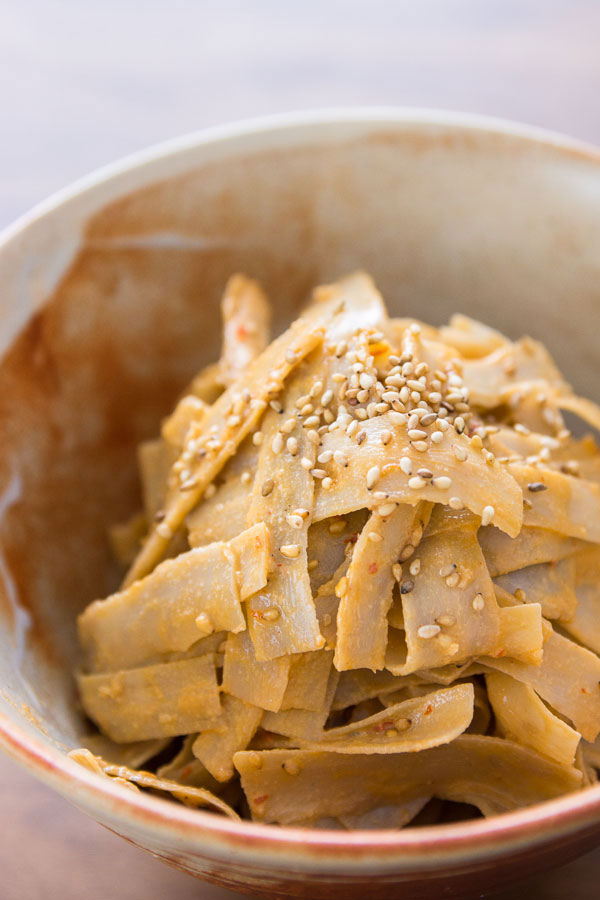
    To make this salad I thinly sliced the burdock and lightly boiled it, which cooks it while preserving its texture. The dressing is made with rich, creamy tahini, flavorful toasted sesame oil, and crunchy whole toasted sesame seeds. It’s a nutty trifecta that not only compliments the earthy flavor of the burdock; it compliments its nutritional value as well, with additional fiber, protein, thiamin, copper, and phosphorous.


    Burdock Salad with Three Sesame Dressing

    burdock-salad640x360
    This burdock salad recipe with three sesame dressing has many healthy minerals and an earthy flavor. 
     Ingredients
    • 1 tablespoon clear vinegar or lemon juice
    • 340 grams (12 ounces) burdock root
    • 3 tablespoons tahini
    • 1 tablespoon toasted sesame oil
    • 1 tablespoon toasted sesame seeds
    • 2 teaspoons soy sauce
    • 1 teaspoon brown sugar
    • 1 teaspoons Doubanjiang (chili bean paste)
    • 2 teaspoon rice vinegar
    • 1 teaspoon grated fresh ginger

    Directions

    1. In a large bowl add 1 tablespoon of vinegar and fill the bowl with water.
    2. Peel the burdock one at a time, trim the ends, and cut them into 3” lengths. Put the pieces into the acidified water immediately. Repeat with the rest of the burdock.
    3. Use a mandolin or sharp knife to slice the burdock into very thin ribbons, adding the sliced burdock back into the bowl of water as you work.
    4. Put a pot of salted water on the stove and bring it to a boil.
    5. While you wait for the water to boil, add the tahini, toasted sesame oil, toasted sesame seeds, soy sauce, brown sugar, Doubanjiang, rice vinegar and grated ginger into a large bowl and whisk together.
    6. Drain the burdock and add it to the boiling water. Cook the burdock for 2 minutes if you sliced it on a mandolin, or a little longer if you sliced it by hand. They should be translucent and no longer stiff, but should still be crunchy.
    7. Drain the burdock, and then put the hot burdock into the bowl with the dressing. Mix well to combine.
    8. Serve the salad warm with steamed rice or let it cool to room temperature and serve with mixed greens.
    Yield: 4 servings


    http://givelifenursery.blogspot.com/p/blog-page_75.html

    Top 20 Reasons Why Moringa Is Amazing For Your Health

    Top 20 Reasons Why Moringa Is Amazing For Your Health


    If you are looking for a miraculous plant that is versatile in its medicinal use and a perfect health booster, then you are at the right address! The so called “Tree of Life” or Moringa oleifera might be a cure of your dreams!
    So, if you need to treat serious medical problems such as allergies, anxieties and depression, diabetes, cancer risk, infertility, heart and blood pressure problems or you simply want to boost your energy, then by all means, continue reading!
    You will find out about the numerous health benefits of the moringa plant and how to use it efficiently! Can you imagine – the traditional Ayurveda medicine claims that the moringa plant can cure around 300 diseases! See it for yourself….

    What Is Moringa?

    MORINGA NAMES – Moringa or a “miracle tree” has several names, according to the Wikipedia source – its widely used names are: drumstick tree (moringa has long seed-pods), horseradish tree (the taste of moringa is similar to that of a horseradish), ben oil tree, or benzoil tree (moringa oil is extracted from the moringa seeds).
    Other, perhaps less known names of the moringa plant are: “kelor, “kalor, “sigru, “malunggay. In the various parts of the world, it apparently has various names – to name a few, in Hindi it is called “sahijan or in Tamil it is called “munaga rungai while it’s Punjabi name is “sanjina. Moringa is perceived as one of the most useful plants. Moringa is therefore also called an elixir tree” or “the medicine cabinet of mother nature” for the facts that all of the moringa parts (moringa seeds, moringa flowers, moringa leaves and moringa buds) can be used both for medicinal and nutritional purposes.

    MORINGA PROPERTIES

    Moringa tree is well known in the traditional medicinal use of Africa and Asia but moringa’s recently discovered medicinal treasures are fairly lately being used in America and in Europe.
    The uniqueness of the moringa plant is to be found in its medicinal and healing properties but also in the fact that it is an ecologically efficient plant used to combat deforestation and so contributes to the preservation of our planet! Moringa trees thrive best in dry and sandy areas and are not easily affected by drought.

    MORINGA ORIGINS

    According to various sources, the moringa plant is presently cultivated predominantly in India. However, Africa, Cambodia, Carribean Islands, Pakistan, Phillipines, Taiwan and Thailland are its important producers. Even though it is for the most part grown in Asian tropical and subtropical climates, the U.S. and Mexico value maringa tree for its medicinal and nutritional properties.

    MORINGA NUTRITION FACTS

    Increasing interest in the production of moringa tree is founded in certain scientific studies on moringa health and medicinal benefits – the studies claim that 30 grams of moringa supposedly contains seven oranges worth on vitamin C, four carrots worth on vitamin A, three bananas worth on potassium and four glasses of milk worth on calcium! Moringa is thus a super food that not only provides us with the vitamins that we need, but also improves our overall health too.
    Being packed with nutrients, moringa is obviously an extremely rich source of calcium, chromium, iron, magnesium, potassium, selenium, and zinc, and of vitamin A, vitamin B complex, vitamin C, D, E and K. As mentioned previously, all of the moringa tree parts are equally useful: moringa seeds, moringa leaves, moringa flowers, moringa pods.
    To illustrate the potency of the moringa plant, here is a nutritional value overview of what a portion of maringa leaves contains:

    Moringa plant portion:

    • Amino-acids 18
    • Antioxidants 46
    • Anti-inflammatory agents 36
    • Nutrients 92
    Moringa tree parts are predominantly edible – some use the pods for cooking, while others eat the leaves or roots. Moringa oil can be extracted from the moringa seeds. The moringa plant flowers are similar to mushrooms. The leaves can be prepared as spinach, or can be used as dried additives to soups and other meals. The pods can be eaten fresh while roots can be used as a horseradish sauce.

    Moringa leaves

    Moringa leaf is, according to some, the most nutritious part of the moringa tree. In traditional African medicine, the moringa leaves are used for malnutrition treatment and for reduction of blood sugar levels.

    Moringa seeds

    Experiments have shown that moringa seeds attract particles of dirt, bacteria and chemical products when planted in pots. It is assumed that they instigate the same process in our blood stream by extracting toxins in order to detoxify our bodies!  When eaten raw, moringa seeds are used for the treatment of liver and spleen problems and are equally good for joint pain. Additionally, the moringa seeds have high contents of fiber and proteins and are therefore good in treating diarrhea and malnutrition. Moringa seeds are effective against skin-infections and are a potent antibiotic and a fungicide.

    Moringa pods

    Seem to be the tastiest part of the tree. Regular consumption of moringa pods in combination with honey and moringa flowers is claimed to positively affect our libido.

    Moringa flowers

    Moringa flowers’ juice improves the quality and flow of breast milk in nursing. Further, the moringa flower juice is helpful with urinary problems and can stimulate urin disposal. Haitians boil moringa flowers and make tea for cold treatments.

    Moringa roots and bark

    The roots and bark are used for heart and circulatory problems. The bark is also an appetizer and a digestive. Maringa roots mashed and mixed with salt can be applied in rheumatism treatments. The same type of moringa roots paste can be used for treating kidney and lower back pains.

    Moringa gum

    Just as the moringa flowers, the moringa gum is diuretic. It is also used against astma (caution with gum use is recommended in cases of pregnancy).

    Moringa oil

    Moringa oil is used for prostate and bladder issues, scurvy and allegedly even for hysteria! Moringa oil treats stomach complaints. Surely enough, moringa oil is also good for hair treatments and it is applied both in perfumes and as hair oil.

    What Are the Top 20 Health Benefits of Moringa?

    Moringa acts as an immune system and energy booster and can even prevent the risk of certain diseases. Its versatility can go from treating skin diseases, diabetes or sleeping problems to combating cancer and AIDS!
    Here selected are the most impressive 20 moringa health benefits:
    1. Moringa is a potent energy booster 
    2. Moringa stimulates metabolism 
    3. Moringa burns fat and builds muscles 
    4. Moringa reduces fat 
    5.Moringa builds and recovers muscles 
    6.Moringa protects skin, nails, hair, teeth and bones 
    7.Moringa protects eyesight 
    8.Moringa reduces cholesterol and hypertension 
    9.Moringa combats diabetes 
    10.Moringa stimulates digestion 
    11.Moringa revitalises memory capacity 
    12.Moringa keeps good mental balance 
    13.Moringa regulates thyroid
    14.Moringa protects heart
    15.Moringa treats stomach ulcers
    16.Moringa acts as diuretic and protects our kidneys
    17.Moringa combats cancer
    18.Moringa treats anemia
    19.Moringa provides sexual potency
    20.Moringa protects liver

    What Are Moringa Benefits for Your Skin?

    Moringa is said to be good for our skin too! Why exactly? For the fact that moringa contains high concentration of tyrosine (crucial in melanin production), calcium, and copper, that are perceived as important nutrients for healthy skin. When it comes to various skin treatments, moringa is a true life saver, as shown here below:
    • Moringa stops wound bleeding by the application of fresh leaves.
    • Moringa has an anti-bacterial and anti-inflammatory effect when it is applied to insect bites.
    • Moringa can be used against bacterial or fungal skin complaints.
    • Moringa can treat minor skin cuts and bruises.
    • Moringa body butter is beneficial for reducing skin dryness and leaves the skin smooth and moisturized.

    What Are Moringa Benefits for Your Hair?  

    Here are several major benefits of moringa oil for your healthy hair:
    Moringa promotes hair growth and fights against hair lossmoringa B vitamins are crucial in stimulating healthy blood circulation and cell regeneration
    Moringa cures hair dryness and moisturizes hair moringa oil is surely beneficial to our scalp and its regular use can prevent scalp and hair dryness
    Moringa eradicates hair dandruff – rich in zinc, moringa will stimulate sebum production and, being packed with vitamin A, will prevent scalp and hair dryness and subsequently eradicate dandruff.

    Are There Any Moringa Benefits for Your Weight Loss?

    Supporters of moringa products will claim that moringa is a miracle plant for weight loss while others might have a somewhat moderate stand on the issue of moringa benefits for weight loss.
    In any case, as it is full with nutrients and anti-oxidants, whether used is capsules or as moringa powder for weight loss, it will surely contribute to our weight loss if combined with proper diet and exercise regime.
    Moringa proponents will name the following moringa weight loss benefits:
    • It is full of fiber so it makes us fill eat less
    • It prevents constipation
    • It prevents blood sugar fluctuations, thus, reduces the chances of sudden cravings for certain foods
    • Contains anti-oxidants that act as fat burners

    How to Consume Moringa?

    Moringa can be made into pastas, breads and porridges as it increases the nutritional value of our meals. What is more, moringa products are various and are offered as: moringa leaf powder, moringa capsules, moringa tea, moringa vitamin supplements. Moringa capsules reviews are positive proclaiming the moringa capsules to be safe. It is recommendable to consume the moringa capsules or moringa B vitamins twice a day. Moringa tea bags are rather convenient for use and can be a good vitamin supplement.
    Now that you have discovered the potential of the moringa plant and its energizing effects, you might even opt to use it for your overall health improvement. However, it is wise to consult your doctor before you decide to include Moringa products into your diet!

    Are There Any Moringa Side Effects?

    There are no proven or officially reported side effects of moringa organic products so if you are not in the category of people described here below, you might take advantage of moringa’s health and energy boosting benefits….

    Caution tips

    Despite the impressive moringa benefits, it is necessary to add that some caution measures are recommended in cases of pregnancy or breastfeeding (there are some contradicting statements whereby some say it is good for milk production while others say it might stop it!).
    Additionally, some claim that moringa might affect one’s fertility and due to its astringent properties can cause miscarriages. Moringa can assist people with allergies as it has anti-histaminic properties but strangely enough, there are some cases of moringa allergy and strong reactions to moringa products. Naturally, it is then advisable to stop moringa usage and consult your doctor once again. For some, moringa can be ideal for their health and for others, it is a less recommendable choice.


    http://givelifenursery.blogspot.com/p/blog-page_97.html